
Understanding Face Cards in a Deck: The Royal Trio You Need to Know
 By Akanksha Mishra
March 05, 2026
By Akanksha Mishra
March 05, 2026
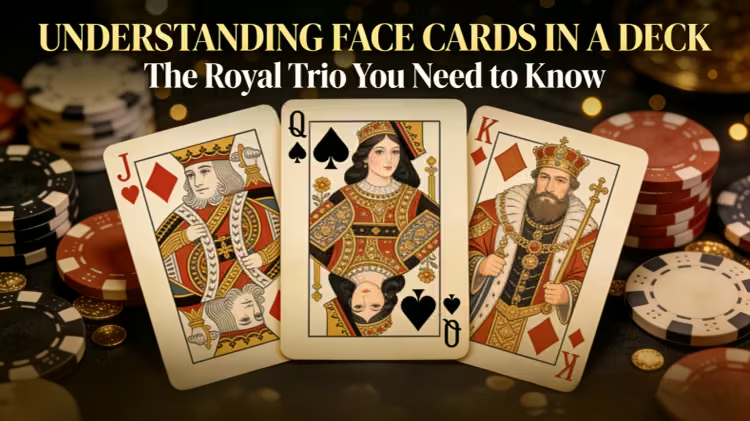
Every time you pick up a deck of cards, twelve of those 52 cards carry something the others do not have a face. The Jack, Queen, and King are not just decorative figures printed in ink. They are the power players of the deck, carrying centuries of history, royal symbolism, and strategic weight in every game they touch.
Whether you are a casual player who enjoys a round of Rummy with family or a competitive Poker enthusiast calculating odds at every turn, face cards are the cards that change the game. Their presence in your hand can shift momentum, complete winning combinations, and intimidate opponents.
This guide covers everything worth knowing about face cards from their ancient origins and symbolic meaning to how they are valued in today’s most popular card games. If you want to understand your deck more deeply and play smarter, this is where to start.
What Exactly Are Face Cards?
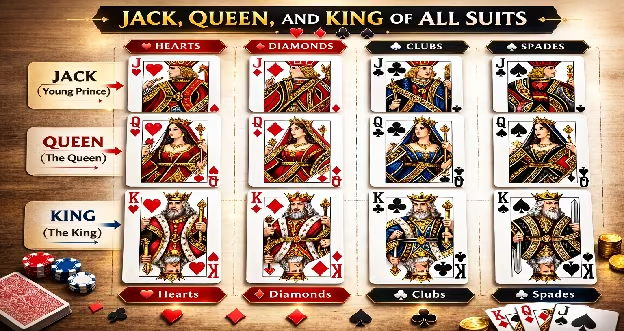
A face card is any card in a standard deck that depicts a human figure. In the traditional 52-card French-suited deck used worldwide, there are three types of face cards: the Jack, the Queen, and the King. These twelve cards, three per suit across four suits stand apart from the remaining forty numbered cards, also called pip cards, because they carry illustrated portraits rather than simple numerical symbols.
Face cards are also commonly referred to as court cards or picture cards. The term “court” comes directly from their imagery: these are cards of the royal court, figures of nobility and power. The term “picture cards” simply refers to the fact that they feature drawn images of people, making them visually distinct from every other card in the deck. While Aces and Jokers may feel equally special, neither qualifies as a face card. An Ace represents a numerical value, and a Joker is a separate entity added later in card history. Face cards are specifically the twelve illustrated royals.
How Many Face Cards Are in a Standard Deck?
A standard deck of 52 cards contains exactly 12 face cards. Each of the four suits Hearts, Diamonds, Clubs, and Spades carries one Jack, one Queen, and one King, making three face cards per suit and 12 in total.
From a probability standpoint, this means you have roughly a 23% chance about 1 in 4 of drawing a face card from a freshly shuffled deck. More specifically, the math works out as 12 divided by 52, which gives a probability of approximately 0.2308 or 23.08%. Six of those twelve face cards are red (belonging to Hearts and Diamonds) and six are black (belonging to Clubs and Spades).
Understanding this number is more useful than it seems. Once you know there are always 12 face cards in a full deck, you can start making smarter in-game calculations particularly in games like Blackjack and Poker, where knowing how many high-value cards remain in the deck directly influences your decisions.
Related Article:- Top 5 Card Games to Play Online in India
The Journey of Face Cards Where Did They Come From?
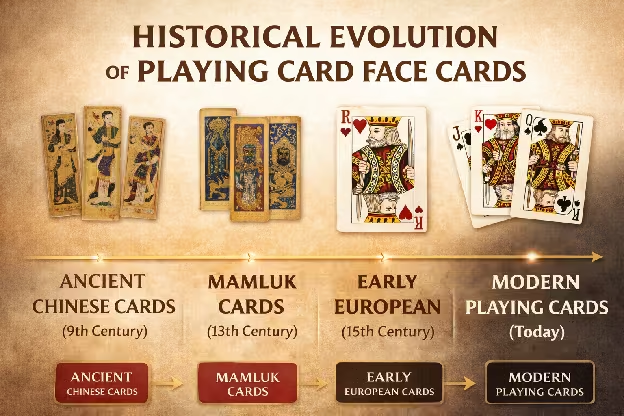
The story of face cards is far older and more travelled than most people realise. Playing cards are believed to have originated in China around the 9th century, likely during the Tang dynasty. Early Chinese card games used painted tiles and strips that would barely resemble today’s deck. From China, cards spread westward through trade routes, making their way to the Islamic world, where the Mamluk card deck featured abstract court figures, a structure that would eventually evolve into the King, Queen, and Jack we know today.
Cards reached Europe through Egypt and the Arab world in the late 14th century, and European card makers wasted little time in reshaping the imagery to reflect their own culture. Early European decks featured Kings and mounted knights, but no Queens. Queens did not appear on playing cards until the 1440s, first emerging in Germany before being formally incorporated into the French card design. The French then made a crucial structural decision: they replaced the Knight rank with the Queen, creating the now-universal format of Jack, Queen, and King.
The Jack has its own fascinating name history. Originally called a Knave, a term referring to a young male servant of the royal household, the card was abbreviated “Kn” for centuries. The problem was that “Kn” looked too similar to “K” for the King, leading to confusion when corner indices were introduced in the 1800s. American card maker Samuel Hart solved this in 1864 by switching the abbreviation to “J” and formalising the name Jack, a term that had already been in informal use in card games for over a century.
Related Article:- Exploring 7 Card Teen Patti: A Fun Twist on a Classic Game
Meet the Royal Court Jack, Queen, and King Explained
Each of the three face cards has a distinct identity, and understanding what each one represents adds a richer layer to your appreciation of any deck.
The King sits at the top of the face card hierarchy. He is shown in full royal regalia crown, robes, and typically a weapon or sceptre in hand. In most standard card games, the King is the highest-ranking face card, surpassed only by the Ace in certain games. Visually, the King features a double-headed design, meaning the figure appears right-side-up from both ends of the card, a design feature introduced in the 19th century to prevent players from accidentally revealing their hand.
The Queen ranks directly below the King. She is the only female figure in the traditional deck, depicted holding a sceptre or an orb. Her introduction into card decks in the 15th century was a significant shift; early decks had been entirely male in their court figures. In many games, the Queen holds the same point value as the Jack and King, but her most unique role appears in games like Hearts, where the Queen of Spades carries penalty points that can swing an entire game in a single turn.
The Jack is the youngest face card, depicted as a youthful male courtier or knight, often shown in motion or carrying a tool or weapon. He ranks lowest among the three face cards in most standard games, though there are exceptions in Euchre, for instance, Jack is promoted to the highest position of all. Despite being the lowest face card, the Jack is far from insignificant. In Poker, a pair of Jacks is a solid starting hand, and in trick-taking games, Jacks have historically been tied to some of the most legendary figures in mythology and literature.
The Hidden Symbolism Behind Each Suit’s Face Cards
One of the most fascinating layers of face card history is the web of historical figures and legendary characters associated with each card over centuries of French card-making tradition. While the English deck does not officially name its court cards after real people, the French tradition assigned specific identities to each face card associations that have persisted in popular culture ever since.
The four Kings are where the symbolism runs deepest. The King of Hearts is traditionally linked to Charlemagne, the Holy Roman Emperor who united much of Western Europe. He is also the only King depicted without a moustache, a detail historians believe was an artistic error made by copyists over centuries that was never corrected. The King of Diamonds carries associations with Julius Caesar, the Roman general and statesman, and is famously shown holding an axe rather than a sword like the other three Kings. The King of Clubs is associated with Alexander the Great, the Macedonian conqueror, embodying military ambition and strength. The King of Spades is linked to King David of Israel, representing wisdom and authority.
The Jacks carry equally rich associations. In the French Paris pattern, the Jack of Spades is connected to Ogier the Dane, a legendary knight of Charlemagne. The Jack of Hearts is linked to La Hire, a fierce French military commander and close ally of Joan of Arc during the Hundred Years’ War. The Jack of Diamonds is associated with Hector of Troy, the greatest Trojan warrior of Greek mythology. The Jack of Clubs has been connected to both Sir Lancelot of Arthurian legend and Judas Maccabeus, the warrior-priest of ancient Judea. These associations bring an extraordinary depth of storytelling to what might otherwise seem like simply decorated cards.
How Face Cards Are Valued Across Different Games
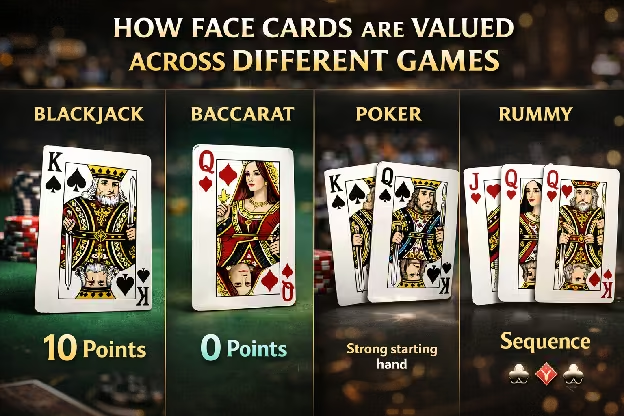
One of the things that makes face cards genuinely interesting is that their value is not fixed; it shifts depending on the game being played. Understanding how different games treat the Jack, Queen, and King gives you a significant advantage at the table.
In Blackjack, all three face cards are worth exactly 10 points each. There is no hierarchy between them in terms of scoring value a Jack equals a Queen equals a King. Combined with an Ace, any face card produces a natural Blackjack, the strongest possible hand. Because face cards share their 10-point value with the number 10 card itself, there are actually 16 cards in a 52-card deck worth 10 points, making high-value draws more likely than many beginners realise.
In Baccarat, face cards take a surprising turn; they are worth zero points. No matter how impressive a King of Spades might look, it contributes nothing to a Baccarat hand. Only numbered cards from one through nine carry scoring value in that game, which completely inverts the usual assumption that face cards are powerful.
In Poker, face cards do not have fixed numerical values. Instead, they hold rank sitting above numbered cards in a suit hierarchy, with the Ace above the King. Their power comes from the combinations they form: a pair of Kings is a strong preflop hand, a King-high flush beats a Queen-high flush, and a royal flush Ace through Ten of the same suit is the most powerful hand possible and includes three face cards.
In Rummy and its variants, face cards are each worth 10 points. This scoring makes them valuable for building high-scoring sets and sequences, but it also means that holding unmatched face cards when an opponent goes out can cost you significantly. Knowing when to hold and when to discard a face card is one of the core decisions in any Rummy game.
Using Face Cards as Your Strategic Weapon
Knowing that face cards exist is one thing. Knowing how to use them is what separates casual players from sharp ones. Face cards appear in roughly one out of every four draws from a standard deck, and understanding how to leverage that probability changes how you approach every game.
In Blackjack, face card awareness is the foundation of basic strategy. Because 16 of the 52 cards in a deck carry a value of 10, you should always assume there is a strong chance the next card drawn will be a 10-value card. This drives key decisions: when you hold 11, doubling down is statistically strong because a face card gives you 21. When the dealer shows a weak card like a 5 or 6, they are likely to bust if they draw one or two high-value cards. Tracking which face cards have already been played is also the basis of card-counting strategies used by advanced players.
In Poker, starting hands that include two high face cards such as King-Queen or King-Jack suited carry strong potential in Texas Hold’em. These hands offer high-card strength, can pair on the board, and can connect to form straights or flushes. However, they require positional awareness. A King-Queen in early position may be strong, but it becomes a liability if someone raises aggressively behind you, suggesting they hold Aces or pocket Kings.
In Rummy, face cards are most valuable when you can use them immediately to form sets or sequences. Three Queens of different suits form a perfect three-of-a-kind set. A Jack, Queen, and King of the same suit form a clean run. The danger comes when you hold face cards that do not connect at 10 points each, they pile up fast if an opponent declares before you can use them. The smartest Rummy players treat unmatched face cards with urgency: deploy them early in strong combinations or discard them before they become a costly liability.
The Evolution of Face Card Design
The face cards you see in a modern deck look very different from what players held in their hands five hundred years ago. Early playing cards featured single-headed figures; the King, Queen, or Jack was depicted fully upright, readable from only one direction. This created a practical problem: players who instinctively turned their face cards upright inadvertently revealed to opponents which cards they were holding.
The solution of the double-headed or reversible design began appearing in the early 19th century and quickly became the universal standard. Double-headed cards show the face card illustration mirrored so the figure appears right-side-up from both ends of the card. This single design change had an enormous impact on gameplay, removing an unintentional tell and making hands much easier to fan and read simultaneously.
The French Revolution also left its mark on face card design. During the revolutionary period of the late 18th century, royal imagery was politically dangerous in France. Card makers redesigned face cards to remove explicit symbols of monarchy crowns, robes, and imperial insignia were stripped out and replaced with more neutral figures. While these “republican” card designs were eventually abandoned and traditional royal imagery was restored, the episode demonstrated just how deeply connected face cards were to the political culture of their time.
Today, face card design is more varied than ever. Traditional decks still feature the time-tested royal imagery established by centuries of European card-making. But custom and novelty decks have exploded in variety featuring everything from pop culture icons and comic book characters to historical figures, animals, and abstract artistic designs. No matter the theme, the structural role of the Jack, Queen, and King remains constant across every deck ever produced.