
3 Patti Rules and Teen Patti Sequence – Complete Guide with Chart & Rankings
 By Akanksha Mishra
Feb 06, 2026
By Akanksha Mishra
Feb 06, 2026
Teen Patti, which literally translates to “Three Cards” in Hindi, is one of the most widely played card games across South Asia. Known by several names — Flush, Flash, and Indian Poker — the game has been a staple at family gatherings, festivals, and increasingly, on online gaming platforms. Its appeal lies in its perfect balance of skill, psychology, and luck. Whether you are sitting down for your first game or trying to sharpen your understanding of hand rankings, this complete guide covers everything you need to know about 3 Patti rules and the Teen Patti sequence list.
What Is Teen Patti?
Teen Patti is a three-card gambling card game that originated in India and bears a strong resemblance to the British game Three Card Brag and, to a lesser extent, traditional Poker. The game is played using a standard 52-card deck without Jokers and accommodates between 3 to 6 players at a table.
The objective of the game is straightforward: hold the strongest three-card hand among all active players at the time of the showdown, or force all other players to fold through strategic betting. The winner takes the entire pot — the collective sum of all bets placed during that round.
Card rankings in Teen Patti follow traditional order. Ace is the highest-ranked card, followed by King, Queen, Jack, 10, and descending down to 2, which holds the lowest rank.
Setting Up the Game
Before a single card is dealt, there is a procedural setup that every player must follow.
The Boot Amount: All players contribute a pre-agreed minimum stake into the pot before the cards are dealt. This initial contribution is called the boot amount (also referred to as the ante). It forms the starting pot and ensures every player has a stake in the game from the very beginning. The boot amount is decided unanimously before play begins.
Dealing the Cards: Once the boot amount is collected, the dealer shuffles the 52-card deck and distributes three cards to each player in a clockwise direction, starting from the player to the dealer’s immediate left. All cards are dealt face down. Players must keep their cards hidden from opponents throughout the round. The dealer position rotates clockwise with each new round, ensuring fairness over time.
How Betting Works in Teen Patti

Betting is the core mechanic that drives the entire game. Once the cards are dealt, players take turns in clockwise order, beginning with the player to the left of the dealer. On each turn, a player has two fundamental choices: stay in the game by placing a bet, or fold and exit the round, forfeiting all money already contributed to the pot.
Blind Player vs. Seen Player
This is one of the most distinctive aspects of Teen Patti rules. Before or during their turn, each player can choose to be a blind player or a seen player.
-
Blind Player: A player who has not looked at their cards. Blind players bet purely on intuition, bluffing, or luck. Playing blind keeps opponents guessing and adds significant psychological pressure to the table.
-
Seen Player: A player who has looked at their cards. Seen players make decisions based on the actual strength of their hand but must wager a higher amount to stay in the game.
The key rule here is that seen players must bet at least double the amount that blind players bet. This betting disparity balances the information advantage that seen players possess.
The Stake Amount Explained
The “current stake” is the baseline betting unit that shifts throughout the game depending on the actions of the previous player:
- If the previous player was a blind player, their bet becomes the current stake for the next player.
- If the previous player was a seen player, half their bet becomes the current stake for the next player.
Blind player betting rules:
- Minimum bet: Equal to the current stake
- Maximum bet: Twice the current stake
Seen player betting rules:
- Minimum bet: Twice the current stake
- Maximum bet: Four times the current stake
Players continue to bet, fold, or request special actions (discussed below) until only one player remains — who automatically wins the pot — or until two players remain and trigger a showdown.
Chaal, Fold, and Other Key Actions
| Action | Who Can Use It | Description |
|---|---|---|
| Chaal | Seen players | Placing a bet to continue playing. Bet must be 2x–4x the current stake. |
| Fold (Pack) | Any player | Dropping out of the round, losing all bets placed so far. |
| Show | Two remaining players | Revealing cards to determine the winner. |
| Sideshow (Compromise) | Seen players only | Privately comparing cards with the player who bet immediately before you. |
Sideshow Rules in Teen Patti
The sideshow (also called a compromise or backshow) is a strategic feature unique to Teen Patti. A seen player may request a sideshow from the seen player who bet immediately before them, provided at least one other player is still active in the game.
Here is how a sideshow plays out:
-
If the request is accepted: Both players privately compare their hands. The player with the weaker hand must fold immediately. If both hands are equal in rank, the player who requested the sideshow must fold.
-
If the request is declined: No cards are revealed. The betting simply continues to the next player.
It is also worth noting that if a player declines a sideshow request twice, they are obligated to accept the third request. Blind players cannot request nor be requested for a sideshow under standard rules.
The Showdown
A showdown occurs when only two players remain active in the game and one of them bets for a show. At this point, both players reveal their cards, and the player with the higher-ranking hand wins the entire pot.
Showdown Rules:
- A showdown cannot take place until all other players have folded.
- Both players’ cards are exposed and compared openly.
- If the two hands are equal in rank, the player who did not pay for the show wins the pot.
- If a blind player is involved in the showdown, the cost of the show equals the current stake. If both players are seen, the show costs twice the current stake.
Teen Patti Sequence List – All 6 Hand Rankings
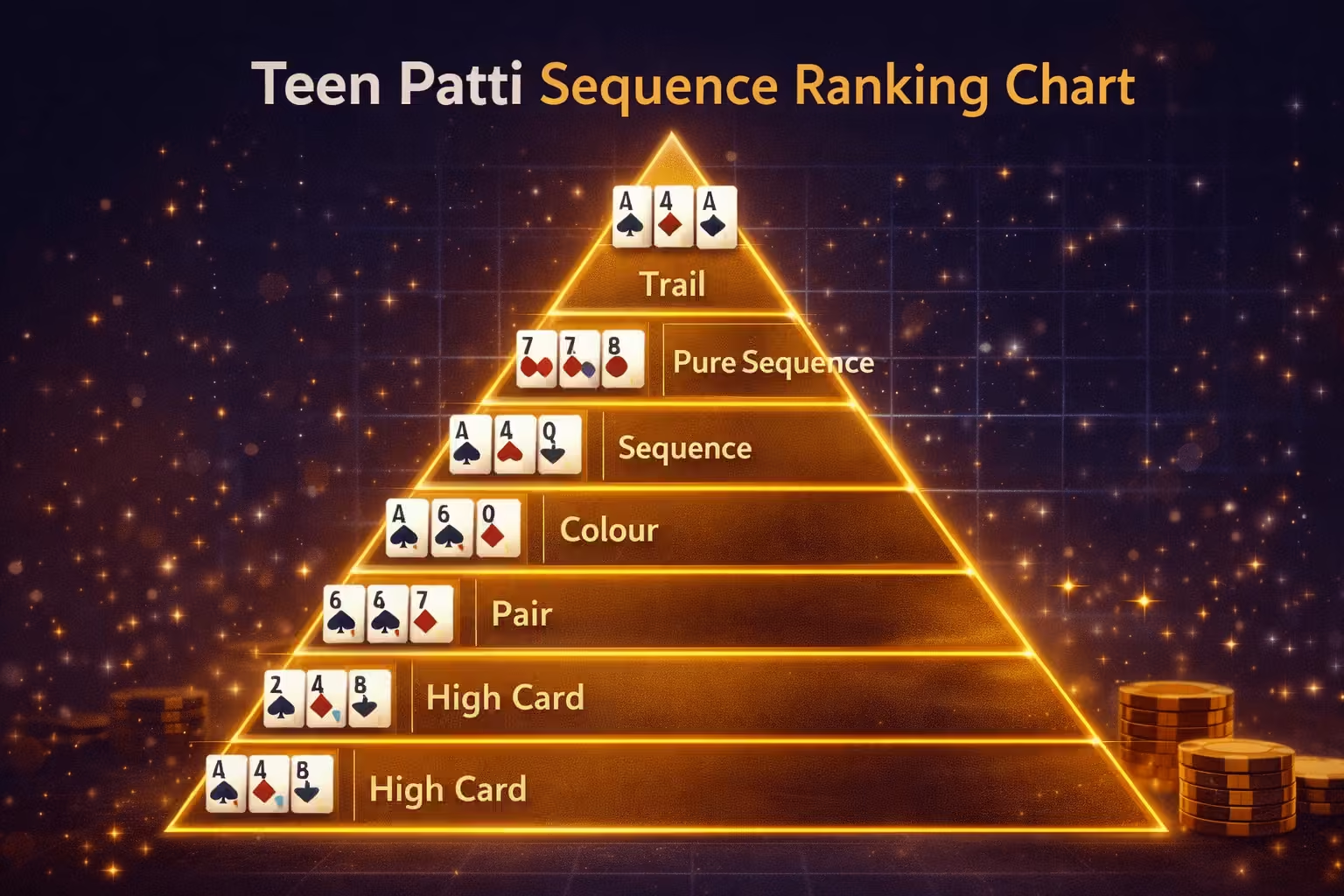
Understanding the 3 Patti sequence chart is fundamental to playing the game well. There are six possible hand types in Teen Patti, ranked from highest to lowest. Any hand of a higher category automatically beats any hand of a lower category, regardless of the specific cards involved.
1. Trail (Trio / Three of a Kind / Set)
Rank: 1 — Highest Hand
A Trail is formed when all three cards in a hand share the same rank, regardless of their suit. It is the strongest hand in all of Teen Patti.
- Best Trail: Three Aces (A-A-A)
- Worst Trail: Three 2s (2-2-2)
Three Aces will always beat three Kings, three Kings will beat three Queens, and so on down the line. A Trail is a rare hand, which is precisely why it commands the top rank.
2. Pure Sequence (Straight Flush / Pakki Run)
Rank: 2
A Pure Sequence consists of three consecutive cards that all belong to the same suit. It is also known as a Straight Flush or, in Hindi, Pakki Run.
- Best Pure Sequence: A-K-Q of the same suit
- Second Best: A-2-3 of the same suit
- Lowest: 4-3-2 of the same suit
Important note: K-A-2 is not a valid Pure Sequence in standard Teen Patti rules, as wraparounds are not permitted. The ranking descends from A-K-Q, then A-2-3, followed by K-Q-J, Q-J-10, and so forth down to 4-3-2.
3. Sequence (Straight / Normal Run)
Rank: 3
A Sequence (also called a Straight or Normal Run) is made up of three consecutive cards that do not all share the same suit. The structure is identical to a Pure Sequence, but the mixed suits lower its rank.
- Best Sequence: A-K-Q of mixed suits
- Second Best: A-2-3 of mixed suits
- Lowest: 4-3-2 of mixed suits
The same wraparound restriction applies here — K-A-2 is not a valid sequence. When two players both hold a Sequence, the one with the highest top card wins.
4. Color (Flush)
Rank: 4
A Color hand contains three cards of the same suit that are not in consecutive order. Think of it as a Flush in standard Poker terminology.
- Best Color: A-K-J of any single suit
- Lowest Color: 5-3-2 of any single suit
When two players both hold a Color hand, the comparison begins with the highest card. If those match, the second highest card is compared, and if those also match, the third card decides the winner. If all three cards are identical in value, the suit ranking applies — Spades outrank Hearts, Hearts outrank Diamonds, and Diamonds outrank Clubs.
5. Pair (Double)
Rank: 5
A Pair is formed when two of the three cards share the same rank. The third card, known as the kicker, serves as a tiebreaker when two players hold pairs of identical rank.
- Best Pair: A-A-K (Pair of Aces with a King kicker)
- Lowest Pair: 2-2-3 (Pair of 2s with a 3 kicker)
When comparing two Pair hands, the higher pair wins. If two players hold the same pair (e.g., both have a pair of Jacks), the kicker card decides the winner. The higher the kicker, the stronger the hand.
6. High Card
Rank: 6 — Lowest Hand
A High Card hand is dealt when none of the above combinations are formed — the cards are not consecutive, not of the same suit, and do not form any pair. In this case, the hand is simply ranked by the highest individual card.
- Best High Card: A-K-J of mixed suits and different ranks (same as best Color but in different suits)
- Lowest High Card: 5-3-2
If two players both hold a High Card hand, the comparison proceeds from the highest card down to the lowest until a difference is found.
Related Article:- 3 patti octro free chips code
3 Patti Sequence Chart – Quick Reference
| Rank | Hand Name | Description | Example |
|---|---|---|---|
| 1 | Trail (Trio) | Three cards of the same rank | A♠ A♥ A♦ |
| 2 | Pure Sequence | Three consecutive cards, same suit | 7♥ 8♥ 9♥ |
| 3 | Sequence (Straight) | Three consecutive cards, mixed suits | 7♠ 8♦ 9♥ |
| 4 | Color (Flush) | Three cards of same suit, not in order | 2♣ 7♣ J♣ |
| 5 | Pair | Two cards of same rank | K♠ K♦ 9♥ |
| 6 | High Card | No combination formed | A♠ 9♦ 4♣ |
Tiebreaker Rules in Teen Patti
When two players hold hands that fall into the same category, the following tiebreaker rules apply:
- Trail vs. Trail: Higher rank wins (A-A-A beats K-K-K).
- Pure Sequence vs. Pure Sequence: Higher top card wins (A-K-Q beats A-2-3 in most variants). If top cards are equal, the suit of the cards is used as the final tiebreaker, with Spades being the highest, followed by Hearts, Diamonds, and Clubs.
- Sequence vs. Sequence: Higher top card wins, same logic as above.
- Color vs. Color: Highest card compared first, then second, then third if needed.
- Pair vs. Pair: Higher pair rank wins; if equal, the kicker card decides.
- High Card vs. High Card: Highest card compared progressively.
Related Article:- how to play teen patti
Popular Teen Patti Variations
While the core game follows the rules outlined above, Teen Patti has spawned a wide variety of popular game modes that add new layers of strategy and excitement.
Muflis (Lowball): The entire hand ranking is inverted. The lowest-ranking hand in standard Teen Patti becomes the winning hand here. A High Card beats a Trail in Muflis — a complete reversal of the conventional game.
AK47: Aces, Kings, 4s, and 7s are designated as wild cards (Jokers) in this variation. They can substitute for any card, dramatically increasing the chances of high-ranking hands.
999: Players aim to build a hand whose card values total as close to 999 as possible. Face cards and 10s count as zero, while Aces count as 1.
Joker Variations: Some games introduce one or both Joker cards from the deck, which serve as wild cards that can represent any card in the deck. This significantly alters the probability of forming strong hands, especially Trails and Pure Sequences.
Key Tips for Playing Teen Patti Well
Mastering Teen Patti goes beyond memorizing the sequence chart. The game rewards a mix of discipline, observation, and psychological awareness.
Starting with smaller bets is always advisable for those still learning the game dynamics. It preserves your chip stack while you read the table and understand the betting patterns of your opponents. Reckless high-stakes betting in early rounds is one of the most common mistakes new players make.
Playing blind for the initial few rounds is a legitimate and often effective tactic. It signals unpredictability to seen players and puts psychological pressure on those who have looked at their cards. The lower betting requirement also helps conserve chips while keeping you in the game.
Understanding when to fold is equally as important as knowing when to bet. A High Card hand against multiple aggressive seen players is rarely worth defending. Folding early in weak situations is not a loss — it is sound bankroll management.
Observing the betting behavior of opponents provides critical information. A player who consistently raises after seeing their cards likely holds a strong sequence. A player who checks or calls minimally may be playing a weaker hand or executing a slow-play bluff.
Sideshow requests should be used strategically. Requesting a sideshow when you hold a strong hand allows you to eliminate a direct competitor without revealing your cards to the entire table. Declining a sideshow, on the other hand, can be used to project confidence even when holding a modest hand.
Probability of Each Hand in Teen Patti
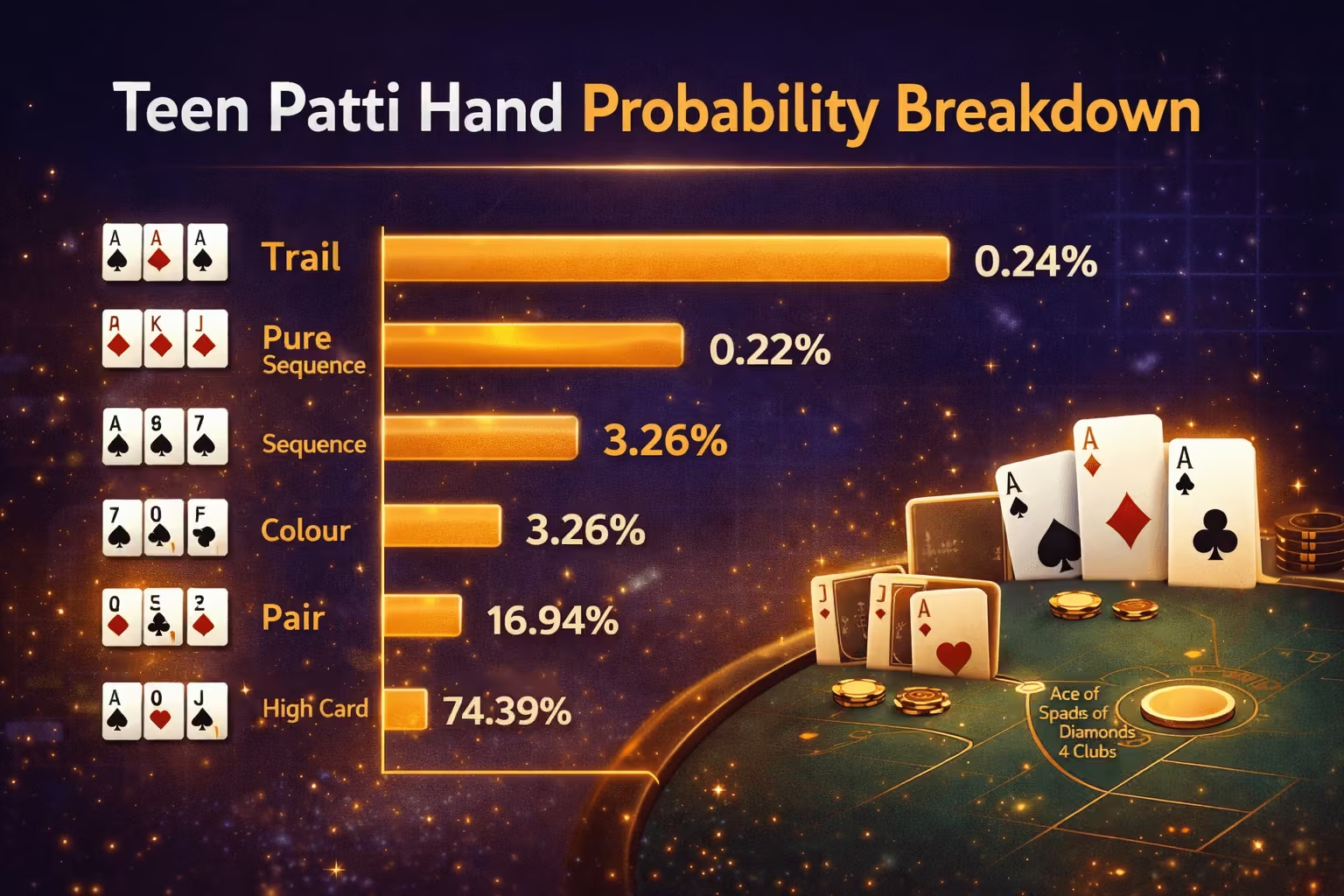
Understanding the probability of landing each hand type can sharpen your decision-making process at the table. With a 52-card deck and no Jokers, there are a total of 22,100 possible three-card combinations.
| Hand | Approximate Combinations | Probability |
|---|---|---|
| Trail (Trio) | 52 | ~0.24% |
| Pure Sequence | 48 | ~0.22% |
| Sequence | 720 | ~3.26% |
| Color (Flush) | 1,096 | ~4.96% |
| Pair | 3,744 | ~16.94% |
| High Card | 16,440 | ~74.39% |
The majority of hands dealt in Teen Patti will be High Card hands. Trails are exceedingly rare, which is why they hold the highest rank. Interestingly, mathematically speaking, Pure Sequences occur slightly less frequently than Trails — yet Trails still outrank them by game convention, a well-established rule accepted across virtually all traditional and online versions of the game.